
An Evening Alone Can Still Be Whole
Empty Space Is Not the Same as Something Missing
Supermarket portions often seem to be made for at least two people.
A bunch of greens lasts three days. A box of tofu has to be divided between two meals. You make half a pot of soup and still end up finishing it yourself. On the way home, you may wonder whether to turn on the television just to give the room a little sound.
These details rarely make it into stories about evenings spent alone.
Sometimes, an evening alone is presented as something carefully curated: candlelight, records, and a thoughtfully prepared dinner. At other times, it is treated as a gap—as though the absence of another person makes the evening somehow incomplete.
Most evenings alone, however, are not particularly remarkable.
You come home, eat, take a shower, and then decide what to do with whatever time remains.
Being alone and feeling lonely are two different experiences. They may overlap, but they do not always arrive together.
Some evenings, the room is quiet and you feel completely at ease. On others, you may come home after dinner with friends and still feel a little empty.
Whether someone else is nearby does not necessarily determine how we experience the time.
Weekend evenings can make this especially noticeable.
There is no need to wake up early the next day, nowhere you have to be, and nothing that absolutely needs to be finished. When time suddenly opens up, it can be difficult to know what to do with it.
We sometimes interpret this kind of open space as evidence that something is missing.
But having no plans does not make the evening less valuable.
It may simply be a stretch of time whose shape has not yet been decided.
Bring Your Attention Back to What Is Here
Dinner for one might mean carefully cooking a dish you love. It might also mean reheating yesterday’s leftovers.
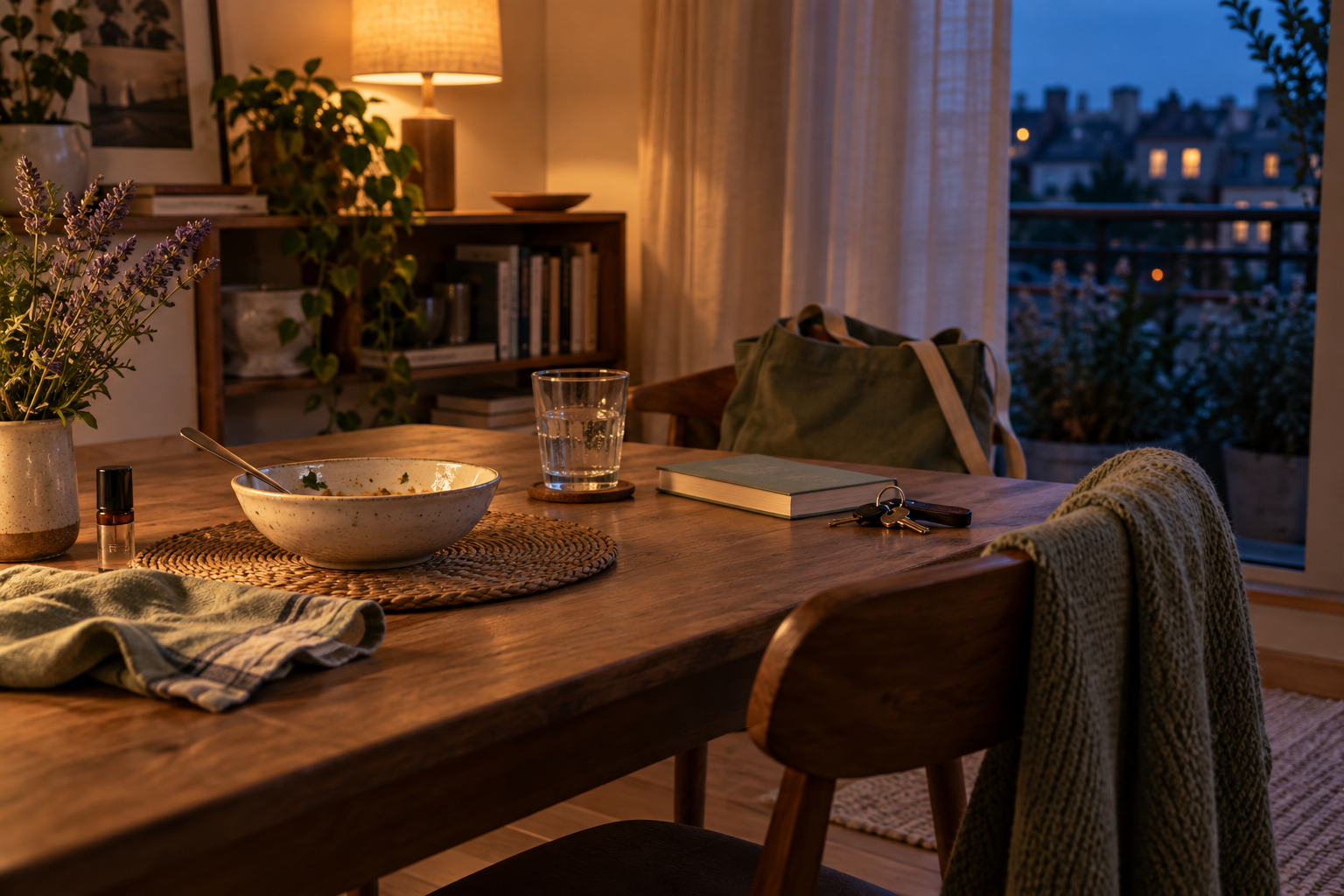
After a shower, you might change into comfortable clothes and sit by the window with a song. You might read a few pages, then set the book aside whenever you feel like it. Or you might slowly gather what you need for tomorrow and leave your keys somewhere easy to find in the morning.
None of these things needs to carry any special meaning.
They do not have to be photographed or turned into a carefully designed lifestyle ritual.
While we are doing them, the evening is already taking place.
If you enjoy scent, a familiar botanical note can also remain quietly in the background.
It might be the faint scent of a lavender roll-on at your wrist or a gentle fragrance in the room.
Scent does not need to answer loneliness or make the evening feel especially beautiful.
Like dinner, light, or music, it can simply be one small detail of everyday life.
Wholeness Does Not Mean Nothing Is Missing
Feeling comfortable on your own does not mean you never need companionship.
Sharing dinner with someone and talking about the day can make for a good evening. Eating alone, washing the dishes, and sitting down to listen to music can make for a good evening too.
Neither way of living needs to prove that it is more complete than the other.
Sometimes we treat time alone as a period of waiting: waiting for friends to be free, waiting for the next gathering, or waiting for someone to enter our life before we begin taking our evenings seriously.
But life does not begin only after the waiting ends.
Tonight’s dinner, the light in the room, and the music now playing are all part of what is happening here.
Not every evening needs to feel full, and we do not have to insist that we enjoy being alone.
Some evenings are ordinary. Some make us miss someone. On others, we simply want to go to bed early.
All of them can be part of a life.
Life does not have to wait until everyone arrives.
Tonight can already be life.
Related Journal